
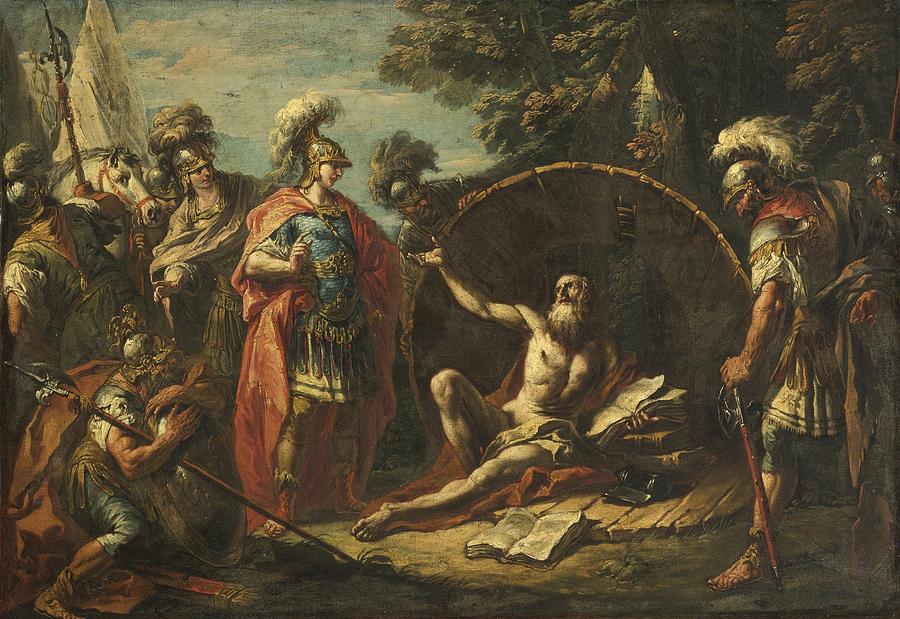
There are a handful of figures throughout history whose lives and ideas are extremely interesting to me: Giacomo Casanova, Lucius Seneca, Fyodor Dostoyevsky, and, today’s subject, Diogenes of Sinope. Not a lot is known about Diogenes. At least, not a lot is really known about him. He seems to be half man and half folktale. Instead of tangible writings, we have countless anecdotes and stories that may or may not be true—the most popular being the story of Diogenes and Alexander the Great.
One day Alexander went out to see Diogenes. He found the philosopher sunbathing naked and asked “is there anything you desire?”. Diogenes looked up at Alexander and replied “yes, stand out of my sun”, to which Alexander, the most powerful man on earth at the time, laughed. With admiration he said “But truly, if I were not Alexander, I would like to be Diogenes”. As Alexander turned to leave, Diogenes replied “If I were not Diogenes, I would also like to be Diogenes”.
Diogenes was born in Sinope (modern day Turkey) in 412 BC. Almost nothing is known about his early life, aside from him being exiled for debasing currency. He moved to Athens where he found Antisthenes, an ascetic philosopher who was a student of Socrates. From that moment on, Diogenes lived an ascetic life—and an eccentric life—and eventually became a founder of the philosophical school of Cynicism.
The Cynics believed the purpose of life is to live in virtue in agreement with nature. They believed man should lead a free and simple life, free from all possessions. The word Cynic is derived from an ancient Greek word meaning “dog-like”. This seemed to be a fitting name for the Cynics because of their rejection of social standards and their decision to live on the street and beg. Cynic philosophy taught self-sufficiency, love of humanity, and indifference to the ups and downs of fortune.
One story says Diogenes destroyed the single wooden bowl he owned when he saw a peasant boy drink from his cupped hands. He exclaimed “Fool that I am, to have been carrying superfluous baggage all this time!”. Diogenes slept on the streets and begged for his food. He scoffed at contemporary Athenian behaviors and acted without shame. It is said that the philosopher would wander through the city in broad daylight with a lamp saying “I am looking for a man”. However, he claimed he found nothing but rascals and scoundrels.
Diogenes the Dog was captured by pirates and sold as a slave in Crete where he became a tutor and passed on his wisdom to Crates, who taught Zeno (the founder of Stoicism). Many parallels can be made between Stoicism and Cynicism.
The stories of Diogenes death are as wild as the stories of his life. Some say he held his breath until he died, others say he died from eating a raw octopus. I doubt he really died from an infected dog bite, but that story is out there as well.
He did not wish to be buried or cremated. Instead he asked to have his body thrown outside of the city walls so animals could feast on his dead body. A man asked him if he minded his body being ripped apart by animals and Diogenes responded “Not at all, as long as you provide me with a stick to chase the creatures away”. The confused man asked, “how will you make use of the stick since you will lack awareness?” To which Diogenes relied “If I lack awareness, then why should I care what happens to me when I am dead?”

Make a one-time donation
Make a monthly donation
Make a yearly donation
Choose an amount
Or enter a custom amount
Never any ads. If you found this entertaining or helpful, consider making a small donation. It’s never expected and always appreciated.
Never any ads. If you found this entertaining or helpful, consider making a small donation. It’s never expected and always appreciated.
Never any ads. If you found this entertaining or helpful, consider making a small donation. It’s never expected and always appreciated.
DonateDonate monthlyDonate yearly
 TheSisyphusBlog