

gen·o·cide
/ˈjenəˌsīd/
noun
the deliberate killing of a large number of people from a particular nation or ethnic group with the aim of destroying that nation or group
One thing I remember clearly from learning about Nazi Germany in school was the majority attitude that most students had. It’s safe to say that every student believed they would not have been complicit in the horrors of Nazi Germany. I could tell by the questions they asked—things like “why did people just let it happen”? When learning about the few heroes who hid Jews or soldiers who refused to commit inhumane actions, it seemed as if the majority of students believed that had they been put into that situation, they would have acted heroically. Even I thought of myself as capable of that kind of heroism—although I had no reason to believe so. I don’t think you can know how you’d act in the face of human atrocity until you have the misfortune of living through it.
Many countries have been criticized for turning a blind eye on what was being done to the Jewish population during World War II. The United States knew about Hitler’s anti-Semitic rhetoric in the 1930’s and were aware that at least two million Jews had been murdered and five million were at risk of being killed in 1942. If adequate attention was paid, who knows how much earlier the world would have reacted. Who knows how many lives could have been spared—how much suffering alleviated.
Who are the Uyghurs
The Uyghurs are an ethnic group that live in modern day Xinjiang, an autonomous region in western China. While there are records of the Uyghurs as far back as the 4th century, the Uyghurs didn’t settle in the Tarim Basin—now Xinjiang—until the 9th century. The Uyghurs are a Turkic people who interacted with the Mongols of Genghis Khan’s time. It’s said that a Uyghur scribe wrote down the pronouncements of Genghis Khan because of the close relation between the Mongolian language and the Uyghur language. In the 10th century the Uyghurs began to become Islamized and by the 16th century they were a majority Muslim people.
In 1759 the Qing dynasty conquered Xinjiang which was then inherited by the Republic of China in 1912. The Uyghurs rose up alongside Uzbeks, Kazakhs, and Kyrgyz and in November 1933 declared independence, forming the First East Turkestan Republic. In 1934 it was conquered by a Soviet-backed warlord. Around this time, the term “Uyghur” became official instead of the generic term “Turkic” that was commonly used. In 1949 Mao Zedong declared victory for the Peoples Republic of China and six years later The Xinjiang Uyghur Autonomous Region was established and it has remained under China’s control ever since.
There is an estimated 12 million Uyghurs living in Xinjiang today which makes up around fifty percent of the regions population (0.31% of the total population in China). However, this is changing quickly as mass amounts of China’s ethnic majority have migrated to Xinjiang in the past few decades.
The Camps
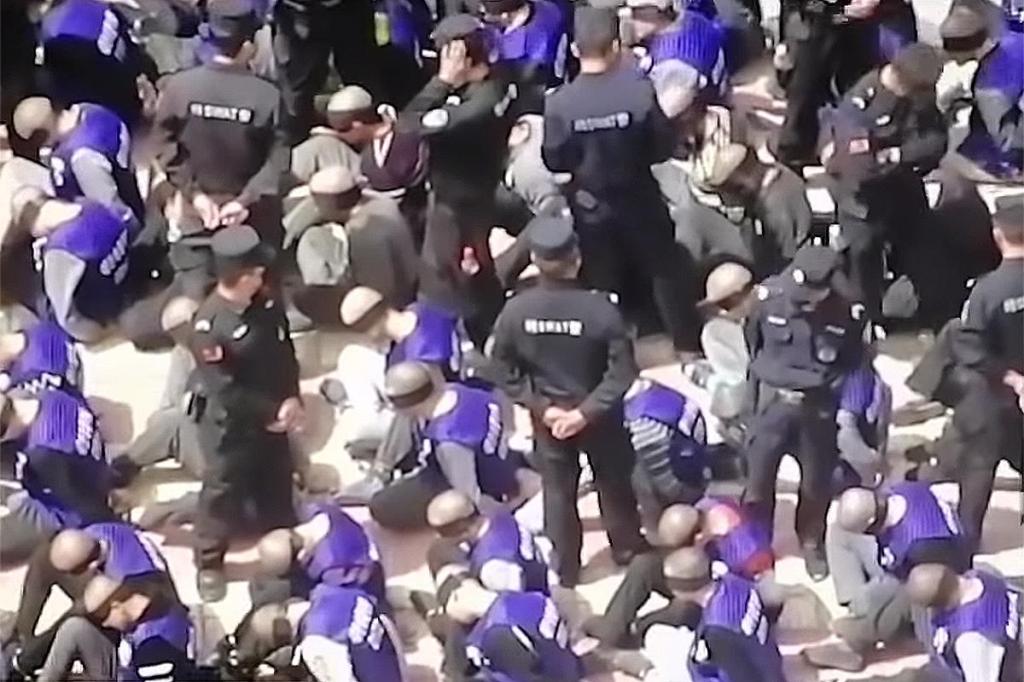
Uyghur Muslims detained, blindfolded, with shaved heads.
In 2017 Xinjiang constituted 21% of all arrests while only having 2% of China’s population. Why are so many people being arrested and where are they going?
China claims to have created what they call “Xinjiang Vocational and Educational Training Centers” in order to fight terrorism. Many Uyghurs are arrested and interned with no trial. Some aren’t even given a reason for their arrest. Uyghurs can be arrested simply for suspicion of “extremism”. According to the Chinese government, signs of extremism include: owning books about Uyghurs, growing a beard, having a prayer rug, and quitting smoking or drinking. All one has to do to understand the ridiculous and arbitrary nature of these arrests, is imagine the same “signs of extremism” warranting the arrest of American citizens. I currently have a beard, a book mentioning Uyghurs, and do not drink or smoke. I would be arrested for terrorist extremism.
The Australian Strategic Policy Institute has identified 380 camps and detention centers. In 2018, U.S Assistant Secretary of Defense for Indo-Pacific Security Affairs, Randall Schriver, said “at least one million but likely closer to three million citizens” were imprisoned in “concentration camps”. One to three million seems to be the consensus estimate.
After being arrested, the detainees heads are forcibly shaved. In 2020, U.S. Customs and Border Protection officials seized 13 tons of weaves and other beauty accessories made from human hair. The hair is suspected to have come from Uyghur camps.
Because of the Chinese governments secretive nature, not a lot is known about what goes on in the camps. Of the handful of people who have spoken about their experiences in the camps there are a few common threads—forced propaganda, electric torture, and rape.
According to a recent BBC article, Tursunay Ziawudun, a woman who spent spent 9 months in a camp, said Chinese men “[paid] money to have their pick of the prettiest young inmates”. Ziawudun also claims women were forcibly fitted with IUDs or outright sterilized. She recounted her own experience, saying “They had an electric stick, I don’t know what it was, and it was pushed inside my genital tract, torturing me with an electric shock”. Her stomach was then stomped on by the guards.
Qelbinur Sedik taught Mandarin Chinese to the inmates. One day one of the police officers told her about the electric devices. “He explained to me that there are four kinds of electric shock torture: the chair, the glove, the helmet, and anal rape with a stick”. The same stick Ziawudun was subjected to.
These stories of electric torture were corroborated by Mihrigul Tursun. She testified that she was locked in a chair and “the authorities put a helmet-like thing on my head, and each time I was electrocuted, my whole body would shake violently and I would feel the pain in my veins”.
It is speculated that these camps are intended to sterilize and eliminate the Uyghur population. The Uyghur birth rate is plummeting. So much so that that the Chinese Embassy in the U.S. tweeted “Study shows that in the process of eradicating extremism, the minds of Uyghur women in Xinjiang were emancipated and gender equality and reproductive health were promoted, making them no longer baby-making machines”. The birthrate in 2017 in Xinjiang was 15.88 births per 1,000 people. In three years it dropped by almost half, and in 2020 the birth rate was 8.14 births per 1,000 people. This massive decline points to the purposeful sterilization of the Uyghur people.
In addition to genocide, forced labor is highly likely in the Uyghur camps. With 84% of China’s cotton production happening in Xinjiang, odds are at least some of it is being handled by prisoners. In 2018 the Financial Times reported that one of the “re-education” camps had opened a forced labor facility containing eight factories that included shoe making and mobile phone assembly.
Ziawudun had her womb removed one week after arriving in the U.S. because of the damage done from being stomped on.
The Response
One of the things that makes me angriest about the Uyghur situation is how long the world has known about it. I first heard about the camps around late 2019 or early 2020. Because of the pandemic, the fact that it wasn’t on everybody’s radar is almost forgivable. However, people have known about the Uyghur camps since at least 2017. In 2017 Human Rights Watch released a report saying “The Chinese government agents should immediately free people held in unlawful ‘political education’ centers in Xinjiang, and shut them down”. Four years of no action taken and almost no reporting until early 2021.
Reporting on the Uyghur camps has been scant up until about four months ago. Major media sources are finally staring to report on the genocide. As of October 2020, 39 countries condemn China while 45 support them. A majority supports China and its actions.
On January 19th, 2021 the U.S Secretary of State designated China’s treatment of the Uyghurs a genocide. Four months have gone by with no plan of action.
What to do
It goes without saying, but the Chinese people are not to be blamed or punished. Instead it is the government who is to blame. The government should be punished. After the end of World War II, the German population wasn’t put on trial. Only high ranking Nazi officials faced prosecution. The Nuremberg trials sentenced twelve men to death and three to life in prison. Even vigilante retribution for the Armenian genocide only resulted in the deaths of a few high ranking Turks who were responsible. An entire people being blamed is what leads to wars and endless retaliation. A war with China is the last thing anyone wants out of this situation. Two nuclear superpowers going to war could easily end existence as we know it—millions if not billions dead.
With such large scale issues, the immediate reaction is to think you have no power. And in reality…you don’t have much power in situations like this. But that may be the wrong way to look at things. You’ll probably know a thousand people in your life and those people will each know a thousand people. That puts you one person away from a million and two people from a billion. You have more influence than you think—even if it’s just through setting an example.
You can always work on your character and become the type of person who could do something. At the very least you could make sure that if imprisoned yourself, you wouldn’t rat out others or do things that go against your conscience.
As an individual you can spread the word and make sure people are aware, for you cannot defeat evil if you don’t see evil. You can also refuse to monetarily contribute to the genocide by not buying goods made in China. It may only be a drop in the ocean, but the ocean is made of droplets and your conscience will be clear.
When faced with human atrocity, how complicit will you be?

 TheSisyphusBlog